.png)
.svg)
Battery Energy Storage Systems (BESS) are gaining significant attention as critical assets in the modern power markets. These systems offer flexibility, enabling them to both inject energy into the grid and withdraw energy when necessary. But how can project developers and asset owners value the revenue potential from BESS participation in power markets? Let’s explore how our platform enables users to optimize their projects and achieve the optimal returns through energy trading.
What Does it Mean to Participate in Power Markets with a Battery?
Participating in the power markets with a BESS opens up various opportunities to generate revenue, but it requires understanding how the system works. To start, certain foundational elements are needed:
- Grid connection and market participation approval: A BESS must be connected to the grid, which is often a time-consuming part for new BESS projects.
- Battery Size: The size of the BESS plays a key role in market participation. To tap into attractive ancillary markets, a battery needs to have a minimum size of 1 MW. The BESS also needs to have certain minimum state of charge depending on the specific market. Smaller systems may still be able to participate in energy trading, but their access to certain market products is limited.
- Operational Constraints: The way the battery is operated can significantly affect its revenue potential. The number of cycles allowed (each cycle represents a full charge and discharge) and the depth of discharge (how deeply the battery is emptied) both influence profitability. More aggressive operational settings lead to higher revenue opportunities but also a higher risk of battery degradation.
Here is where Re-Twin Energy’s platform comes into play. Our solution helps optimize the operational settings of a BESS to maximize revenue while minimizing wear and tear on the asset.
The Role of a Digital Twin in Maximizing Revenues
A digital twin is a virtual replica of your BESS, built using real-time data and advanced modeling techniques. On the Re-Twin platform, creating a digital twin of your BESS is straightforward, and it’s an essential step toward gaining valuable insights into how to operate the system most effectively.
Configuring Your Digital Twin
- Asset Information: Begin by entering key asset details, including:
- Asset Country, Location, and TSO ID: The location impacts grid access, market rules, and potential revenue streams.
- Asset Construction and Operation Date Range: This helps estimate when the asset will reach certain milestones in its lifecycle, affecting its financial projections.
- Technical Setup: Configure technical parameters that describe the battery’s capabilities and constraints:
- Capacity and Power Rating (Storage Hours): These values define the size and scope of the system’s ability to charge and discharge.
- Charging and Discharging Efficiency: These determine how much energy is lost in the conversion process and affect your energy trading margins.
- State of Charge Limits: These values indicate the minimum and maximum charge levels at which the system can operate.
- Allowed Cycles per Day and Battery Degradation: This defines how often the battery can cycle without risking premature failure, influencing long-term asset health.
- Financial Setup: Insert information about Unit Costs, O&M Costs, and Direct/Indirect Costs etc. as a basis to determine the ****impact on the overall cost structure and the return on investment.
- Market-Specific Adjustments:
- Analysis Date Range: Decide which historical data and forecast periods to include in the simulation.
- Bidding Strategy: Choose between pre-set bidding strategies (Day Ahead, Revenue Floor, Base Case and High Risk Merchant) or custom bidding strategies. A high-risk strategy may aim for higher rewards with market participation in Spot markets. But due to prioritization in high risk markets, the uncertainty in revenues is higher.
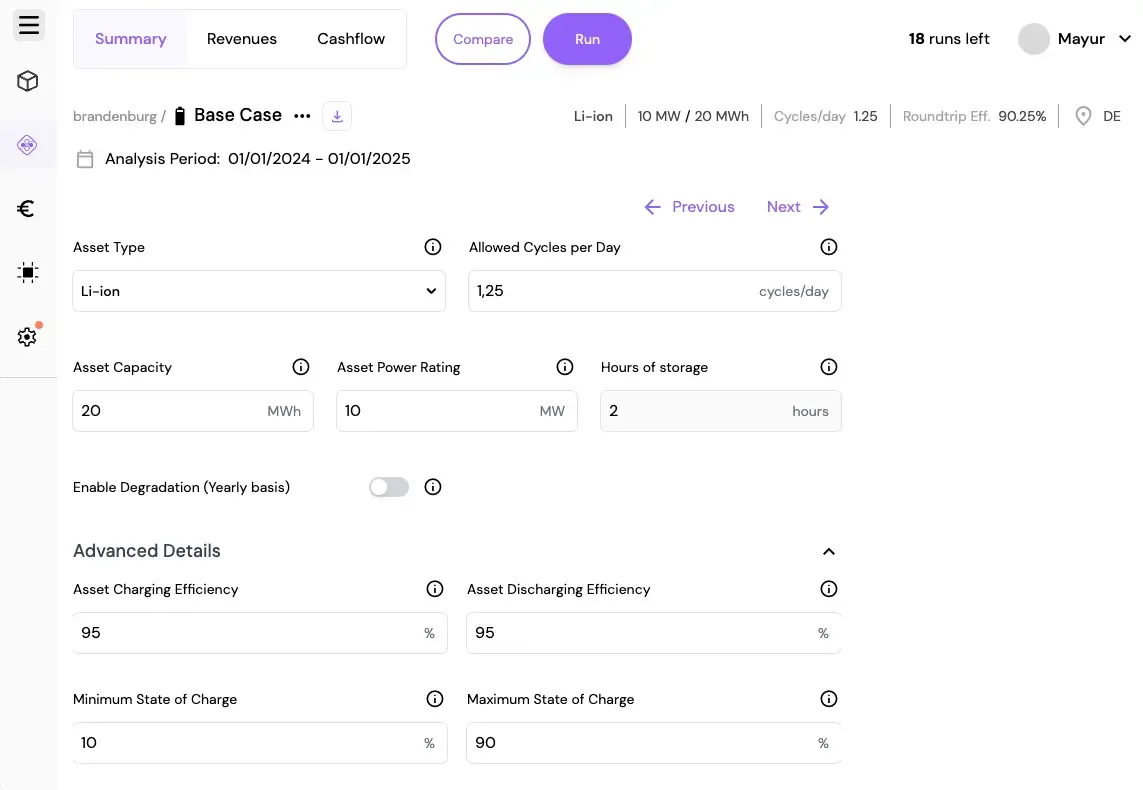
Simulations: Once all the settings are configured, you can run simulations based on AI-driven optimization. Our platform analyzes different operational strategies and market conditions to identify the best possible charge/discharge cycles and market participation strategies.
Insights from the Re-Twin Platform
By using the digital twin model, users can gain actionable insights into maximizing revenue while keeping battery degradation in check. Here’s what you can expect from the analysis:
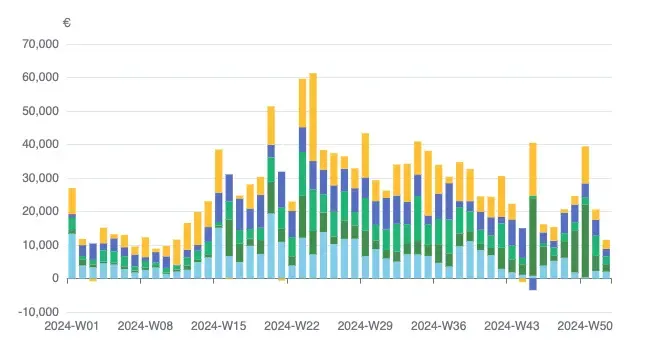
- Revenue Insights: The platform estimates average revenue, IRR, and lifetime revenue based on market conditions and asset performance.
- Battery Life and Degradation: Understand how quickly the battery’s health deteriorates under different operational strategies and make informed decisions to balance profitability and asset lifespan.
- Optimal Charge/Discharge Scheduling: Discover the best times to charge or discharge based on the battery capabilities.
Scenario Comparison: Finding the Best Setup
One of the key features of the Re-Twin platform is the ability to compare multiple scenarios. By adjusting various parameters - such as asset configuration, market participation strategy, and operational constraints - you can identify the most profitable setup for your specific BESS project.
For example, you might compare different financing strategies (e.g., tolling vs fully merchant) or test how altering the number of cycles per day affects both revenue and asset life. The results of these simulations can be compared directly in the tool and downloaded to be integrated into your personal analysis for further evaluation.
Concrete Example: Brandenburg Battery
Let’s walk through a concrete example to illustrate how our platform works:
- Location: Brandenburg, Germany (close to Berlin)
- Technology: Li-ion, 20 MW / 10 MWh
- Operational Parameters: 1.25 cycles/day, round-trip efficiency of 90%, asset unit cost of €200/kWh
- Bidding Strategy: Base Case
- Asset Degradation: Not included
In this scenario, the digital twin simulation predicts that the BESS would have generated €1.4M revenue in the year 2024. Assuming the BESS continues with this revenue for the next years, IRR is estimated at 19.3% for a 6M total investment and a 15-year lifetime. The majority of revenue (43%) comes from participating in the Spot markets (Intraday and Day Ahead).
It's important to note that these results are based on the base case strategy, a balanced cross-market trading approach designed to optimize returns while avoiding volatile markets like aFRR Energy. However, in a high-risk merchant approach, the revenue potential is higher, as this strategy follows a high-risk, high-reward model, capturing top market opportunities.
Our platform enables you to compare these different approaches seamlessly. Additionally, you can configure a custom strategy, fine-tuning it based on:
- Risk Appetite: Prioritizing stability vs. maximizing revenue.
- Market Focus: Emphasizing ancillary services vs. spot market trading.
For a detailed overview of these strategies and predefined case studies, refer to our methodology documentation.
Maximize your BESS’s returns - sign up and try our platform for your project!
Want to configure your digitial twins for your project? Curious how your BESS would perform if power markets change in the future? Try it and see the insights in action: https://app.re-twin.energy/
Conclusion
By leveraging the Re-Twin platform, BESS stakeholders can make data-driven decisions on valuing their asset while managing risk and asset degradation. The digital twin model, combined with AI-driven optimization and scenario comparisons, provides users with clear insights into the best operational strategies for their specific projects.
Whether you’re looking to optimize your battery’s revenue streams, extend its life, or minimize degradation, our platform gives you the tools and insights you need to make fully informed decisions and unlock the full potential of your BESS.
.png)

.png)




%201.svg)
.svg)