Hero

Impact of Day-Ahead Forecast Accuracy on BESS Revenues

Prasad Hadbe
LinkedIn icon
July 6, 2025
3 min
Energy Trading

Battery revenues are often discussed as if the asset simply reacts to market volatility. In practice, a battery earns money by making decisions before prices are known. The forecast decides when to charge, when to discharge, and how much of the daily cycling budget to spend.

That makes forecast quality a commercial lever, not just a modelling metric.

Together with Electricity Maps, we looked at how day-ahead forecast accuracy translates into realized BESS revenues. The question was simple: if two forecasts see tomorrow's German day-ahead market differently, how much does that change what a battery would actually earn?

The Setup

We ran a Jan–Mar 2026 backtest using German 15-minute day-ahead prices. For every delivery day, the battery dispatch was optimized using the forecast available before the day-ahead gate, then settled against the actual day-ahead price.

The analysis compares four signals:

Signal Table
Signal What it represents
Previous-day baseline A simple naive benchmark: tomorrow looks like yesterday
Re-Twin forecast Re-Twin's day-ahead forecast
Electricity Maps forecast Electricity Maps' day-ahead forecast
Perfect foresight The theoretical upper bound using actual prices in advance

The BESS was modelled as a 10 MW standalone battery with 95% charge/discharge efficiency, 10–90% SoC limits. We tested 1h, 2h, and 4h durations, with 1, 1.5, and 2 cycles per day.

This is intentionally a day-ahead-only benchmark. The same approach can be extended to spot-market and fully merchant strategies, but those require matching intraday, balancing, and ancillary forecasts plus realized settlement prices.

What We Found

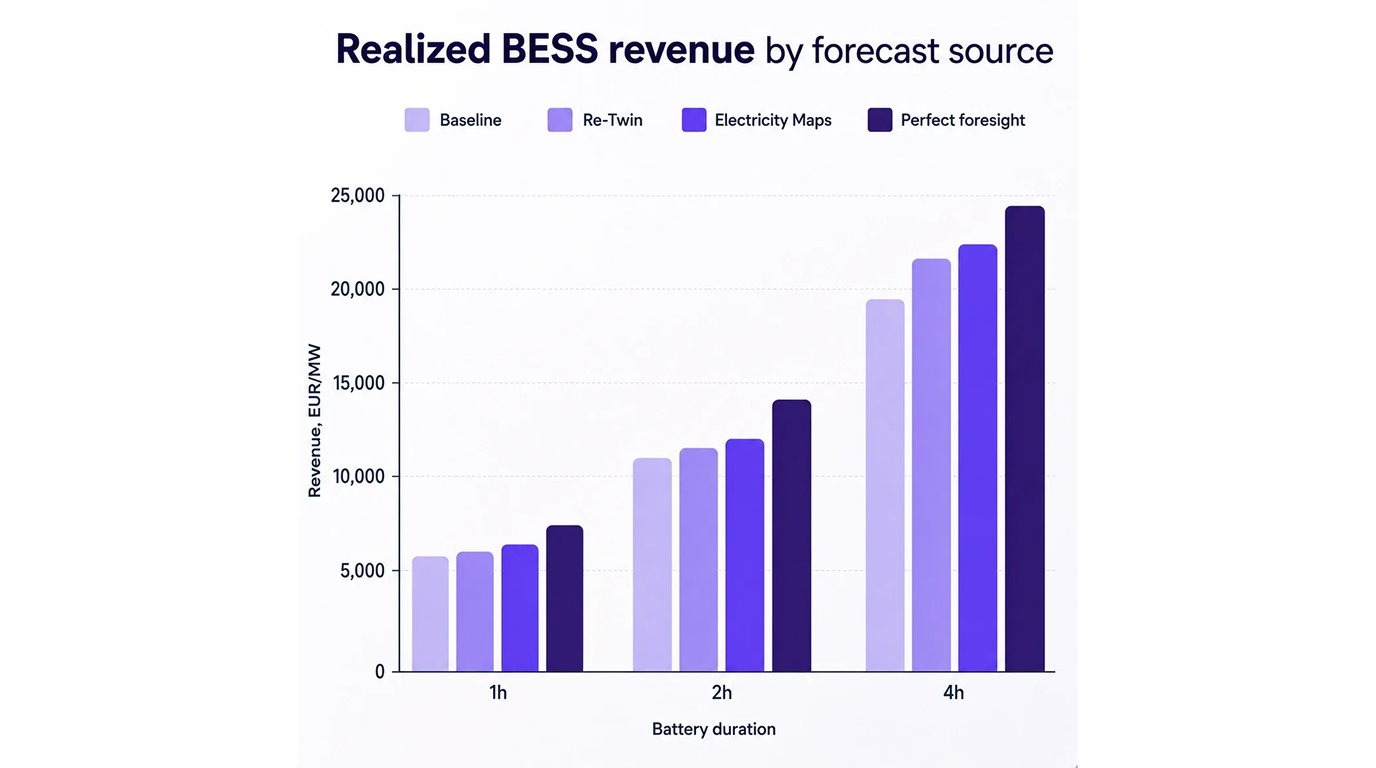
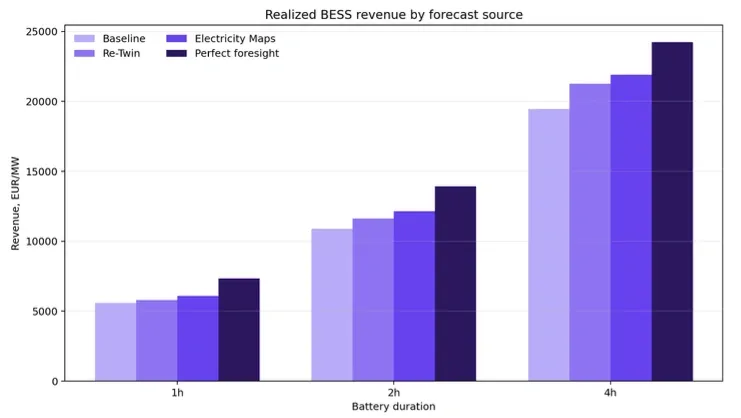
For a representative 2-hour battery with 1.5 cycles per day, Electricity Maps produced the strongest result in the backtest:

Forecast Revenue Table
Forecast
source
Realized
revenue
Revenue captured vs
perfect foresight
Gap to perfect
foresight
Previous-day baseline EUR 10,904/MW 78.4% EUR 3,010/MW
Re-Twin EUR 11,628/MW 83.6% EUR 2,286/MW
Electricity Maps EUR 12,163/MW 87.4% EUR 1,751/MW
Perfect foresight EUR 13,914/MW 100.0% EUR 0/MW

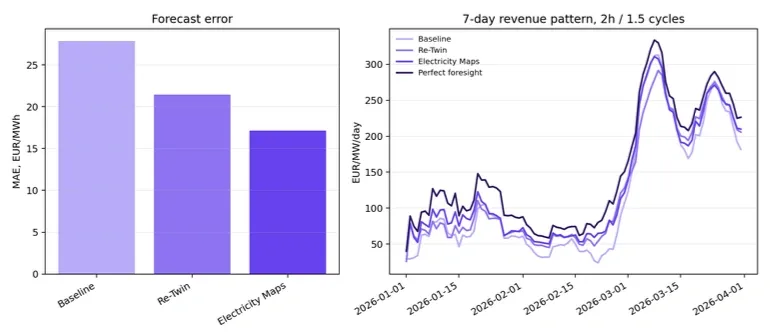
The same pattern appears in the forecast error metrics. Electricity Maps had a mean absolute error of 17.2 EUR/MWh, compared with 21.4 EUR/MWh for Re-Twin and 27.9 EUR/MWh for the previous-day baseline.

The important point is not just that the forecast error was lower. It is that lower error changed the dispatch. The battery made better use of its limited cycle budget, avoided more low-value spreads, and captured more of the revenue that would have been available with perfect information.

Why Accuracy Turns Into Revenue

A BESS optimizer is constrained. It cannot simply trade every spread in the day-ahead curve. It has finite power, finite energy capacity, efficiency losses, SoC limits, and cycle limits. A forecast error therefore has two effects:

  1. It can make the battery charge or discharge at the wrong time.
  2. It can spend scarce cycle budget on a spread that looked attractive in the forecast but was less valuable in reality.

That second effect is where forecast accuracy becomes especially important. A poor forecast does not just miss a price; it can reserve the battery for the wrong opportunity.

In this backtest, the 2h / 1.5-cycle battery using Electricity Maps captured 87.4% of perfect-foresight day-ahead revenue. Re-Twin captured 83.6%. The difference is a practical measure of how much more value the better forecast unlocked from the same physical asset.
AI in Energy Trading
Battery duration

The Takeaway

Forecast accuracy is not an abstract performance statistic for BESS operators. It directly affects market decisions, cycle allocation, and realized revenue.

In this Jan–Mar 2026 German day-ahead backtest, Electricity Maps delivered both lower forecast error and higher realized BESS revenue than the other non-perfect signals. For the representative 2-hour battery case, it reduced the gap to perfect foresight to EUR 1,751/MW, compared with EUR 2,286/MW for Re-Twin and EUR 3,010/MW for the previous-day baseline.

For developers, investors, and optimizers, this is the core lesson: better forecasts help batteries capture more of the value that volatility creates.

About The Author

Florian Heise
Prasad Hadbe
LinkedIn icon

Prasad Hadbe is a Data Engineer with expertise in AI, machine learning, and data science. His work focuses on building intelligent forecasting and analytics systems that transform complex energy-market data into practical business insights. With a strong foundation in data-driven problem solving, he is passionate about applying AI and ML to real-world energy challenges and creating solutions that support smarter, faster, and more informed decision-making.

Ready To Make Smarter Energy Storage Investment Decisions?

Talk to our team. We'll walk you through a live analysis of a real asset in under 30 minutes.

Answers to your questions

How to describe Re-Twin Energy in one sentence?

Re-Twin is your AI-powered digital energy analyst for evaluating, simulating, and optimizing risk vs. return for battery assets.

What is Re-Twin Energy's platform?

Re-Twin is a one-stop SaaS platform with three tools: Data & Insights, Investment Analysis, and Live Benchmarking. Built to make battery storage decisions faster, smarter, and more profitable.

What makes Re-Twin Energy a one-stop-shop?

We support the full asset lifecycle from planning to operation with scenario analysis, trading simulations, and performance benchmarking. Re-Twin answers key questions like:

- Which markets should my battery target?
- How do I balance returns and asset health?
- What profit can I expect from different strategies?

What is a digital twin?

A digital twin is a 1:1 virtual copy of your battery asset (real or planned). It mirrors all changes of your set-up, helping you optimize performance and strategy without risk.

Who can benefit from the Re-Twin Energy platform?

Stakeholders in energy storage (developers, asset owners, and financiers), especially in the battery storage space, use Re-Twin for project planning, strategy testing, and operational performance benchmarking.

What energy storage systems are included?

We focus on battery energy storage systems (BESS), including stand-alone assets and co-located setups like BESS+PV, BESS+Wind, and BESS+Own Consumption.

What does the Investment Analysis module do?

It assesses project viability and profitability using historical and forecast data, helping users explore different asset configurations and market strategies before making investment decisions.

What is Live Benchmarking?

Live Benchmarking is a new performance measuring concept, that shines where generic indices fail to capture your assets unique set-up. It’s a live trading simulator where users test and improve strategies in a risk-free environment to balance returns, risks, and asset degradation. Results act as benchmarks for your trader or asset against real outcomes. This can further be applied to validate assumptions and provide third-party verification.

What type of data does Re-Twin Energy deliver?

Re-Twin provides historical market data and long-term forecast market data (based on FFE & MAON), trading simulations, market-specific revenue projections, cashflows and scenario results tailored to your asset. This data also incorporates degradation, based on your inputs. Project specific parameters can be set to tailor the output.

The Re-Twin Optimizer itself is trained on various data sources incl. price data for spot & ancillary markets from different countries, weather and much more. This means we are also able to generate a PV Generation Profile based on your chosen location.

In which format is the data downloadable?

Data and results can be exported in CSV, Excel, or PDF formats (based on your use case and plan). Downloads are in 1 hour granularity, PRO users get the additional option to download in 15 min granularity.

For which countries is the platform available?

The platform currently supports Germany, Belgium, Austria, Netherlands and Spain with expansion to other European markets underway. Interested in bringing Re-Twin to your country? Get in touch! We are always looking for pilot partner’s to expand to new countries.

How do I get started?

Sign up with a free account to explore the platform and test its capabilities with 2 free runs in Investment Analysis and a free trial in Live Benchmarking. Reach out via our website or info@re-twin.energy for any questions, custom demos and subscription possibilities.

Is training available?

Yes, we offer onboarding and continuous user support to help you get the most out of the platform.

How secure is the platform?

The platform is hosted on Microsoft Azure, using its full suite of security tools. It follows GDPR and industry best practices with full encryption and access protection.

Why choose Re-Twin Energy?

Re-Twin unites AI, deep energy expertise, and a user-friendly design to deliver faster insights, smarter strategies, and better financial outcomes in one solution.